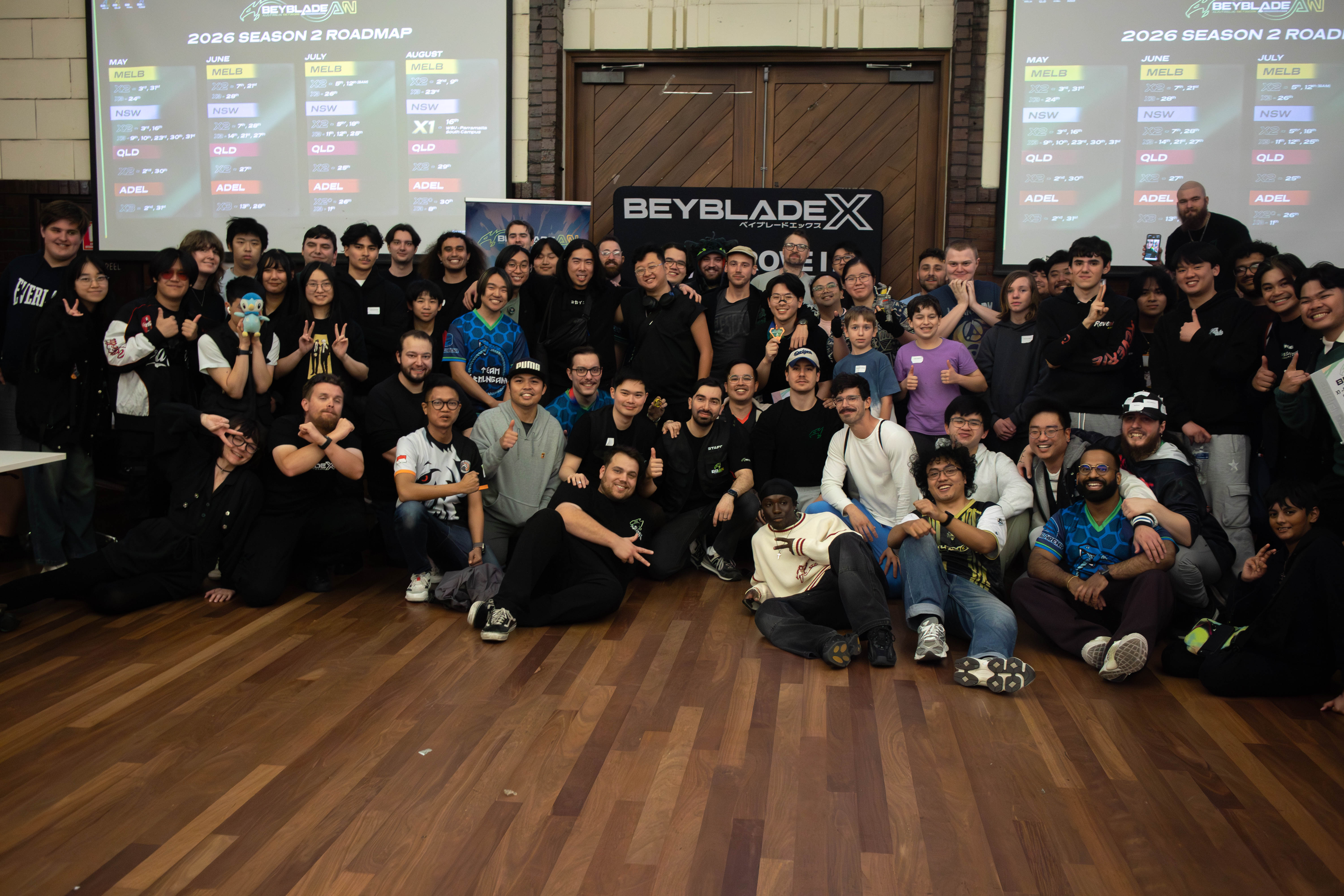
Every Sunday, a random communal space in Melbourne fills with the echoes of clashing metal as two beasts fight. A wizard fights a shark, pegasi battle unicorns, and a wyvern faces a dragon. They face each other in battles of endurance and power.
This isn’t your typical LARP session or Dungeons & Dragons campaign. Over 100 players across the city show their full strength as they compete for one goal: to see if they’re the next Beyblade X champion.
Beyblade is a Japanese franchise launched in 1999 in which players battle with spinning tops, and it has released multiple toys and anime series. Each spinning top falls under one of four categories: Attack, Defence, Stamina, and Balance, creating a somewhat rock-paper-scissors-style battle system depending on how you build your spinning top, or Bey.
In 2023, Beyblade evolved into its fourth generation, Beyblade X, which features tops made from interchangeable metal and plastic parts. It also introduced a new gimmick called “X-Dash,” enabling fast stadium movements known as the “Xtreme Dash.” Its distributor, Takara Tomy, markets Beyblade X as a “gear sport” due to the gear-like movements these toys make.
Melbourne’s Beyblade X scene has a competitive adult community, with regular events attracting dozens or even hundreds of players. Over the past 10 months, I immersed myself in the competitive hobby, attending ranked and casual tournaments. I competed across Melbourne to understand why adults took the game seriously and, more importantly, why they kept coming back.
What I initially saw as just a new version of a childhood toy turned into something much more. But what is Beyblade? Why are adults playing it? And what is it like to be part of this growing community?
My History With Beyblades

Growing up in the Philippines, I was vaguely aware of the first generation of Beyblades, dubbed the “Plastic Gen.” Unfortunately, I was a baby. I couldn’t play with them, but I knew Filipino boys often modified their Beyblades with scrap metal or toothpicks. Yeah… you can see why my folks did their best not to let a toddler play with them, especially with all the tiny parts needed to assemble them.
Years later, Beyblade released its second generation: Beyblade: Metal Fusion, which featured metal blades. By then, I was in high school and old enough to buy them at toy stores. My first blade was Thermal Pisces T125ES, a Stamina-type Beyblade based on the Pisces astrological sign. Why I didn’t get the Aquarius one baffles me to this day, to the point where I had to order one from Facebook Marketplace many years later.
While I didn’t compete during this era, I got to play with these toys with my family and the neighbourhood kids, using either an official plastic stadium or, and I kid you not, a laundry basket, sometimes filled with water for “special effects.” It was fun, and I got to go outside and interact with others. My parents even let me into our neighbours’ houses, where we would battle for hours.
What made playing Beyblade appealing then was the thrill of seeing your blades spin. And when you filled a laundry basket with water, your imagination ran wild whenever it splashed your opponents. We all had so much fun. It was a social activity and a great conversation starter with my peers.
Eventually, we all grew up and stopped. I stored my Beyblades away and never opened the box unless I was looking for something specific. And that was the end of my blading days…
…until.
How Magic: The Gathering Got Me Into Beyblade X
When I moved to Melbourne in 2023, my boyfriend urged me to make friends since I no longer had my village. Everyone I knew lived in Sydney, so I relied on my boyfriend’s social circle. I wasn’t lonely per se, and I did participate in other hobbies, like keyboards and Pokémon. But I wanted a hobby that wasn’t taken over by scalpers or shady people who broke people’s trust.
In May 2025, The Red Bobcat released a video titled “This Comparison NEEDS to be Made.” He compared Beyblade X to MTG, arguing that Beyblade offered a better hobby. Hasbro produces Beyblade X and owns Wizards of the Coast, the company behind MTG.
It covered the basics, the rules, and the types of blades. It also explored the UX Line, or Unique Line, where each Bey has a unique gimmick. Samurai Saber 2-70L caught my attention. Its was an attack-type Beyblade with two small retractable blades. In theory, it would retract when hit, switching from Attack to Defence mode.
Samurai Saber appealed to me because its gimmick reminded me of my first Yu-Gi-Oh! “tribal” deck, the Six Samurai. Months later, I liked it even more after watching its owner, Tenka Shirobashi, utilise it in the Beyblade X anime.
After watching the video, I became interested, but not enough to buy a Beyblade. I still played the Pokémon TCG and didn’t want another hobby. So, I told myself:
“If I see Samurai Saber on shelves, I will buy one and return to playing Beyblades.”

Six months later, I learned that Southland sold Beyblade X prodcuts. On the shelves were the coveted Samurai Saber and a blue Dranzer Spiral remake from the plastic gen. I remember seeing the two and feeling a rush of excitement. Logically, I was thinking, “Don’t do it! You don’t need it,” but at the same time, I was like, “There’s nothing wrong with owning just one or two Beyblades. And if I don’t use them, they’re nice as collection pieces.”
But then came the next question: Where could I compete? I didn’t want my newly bought toys to sit unused forever.
Where To Play Beyblade X In Australia?

When I Googled “Beyblade Events in Australia,” two things popped up.
First, the National Qualifier for the Beyblade World Championship had taken place a few months earlier at Westfield Parramatta in Sydney. That’s when I knew Takara Tomy wasn’t joking about catering to both kids and adults.
The second was a website called “Beyblade Tournaments Australia,” which listed upcoming events across the country where people could compete. I saw one happening at Pixel Bar, which was a venue near my place, and wanted to take part.
The problem was that to play Beyblade X, you needed a deck of three Beyblades with no repeating parts. So I went back to the shops and researched combos on YouTube, working with what I could find. I even used ChatGPT to analyse winning decks shared on World Beyblade Organisation and identify popular parts and combos.
I ended up with seven Beyblades. My first deck was Samurai Saber 9-60L, Soar Phoenix 5-60P, and Dranzer Spiral 3-60T.

The moment I entered Pixel Bar, the venue was full. People have set up stadiums in a few sections, carried toolboxes full of parts, and chatted with each other. I didn’t know anyone except one person I played Pokémon with in the city.
My matches were not great. I kept losing, and everyone had stronger combos and had mastered launch techniques. I didn’t know what I was doing. Some of the judges felt bad and shared some spare parts with me to help me win at least one match… only for me to lose again.
It was rough, but for some reason, I didn’t feel demoralised or let it throw me off. The people I met at the casual gathering were really helpful. They introduced me to online retailers and recommended a better launcher to protect my ripcords. I also discovered I’m terrible with string launchers as it felt like pulling a really light lawnmower. Since it was an end-of-year event with prizes, I also got to witness the meta firsthand and took notes.
The people were so nice, and that’s when I learned about BBAN, the Beyblade Australian Network. They were a non-profit organisation that hosts Beyblade events in Melbourne, Sydney, Brisbane, and Adelaide. They’re Australia’s biggest Beyblade organisers, to the point that they helped run official tournaments in 2025 with Hasbro.
They told me competitive events would resume in January 2026 and that I should attend if I enjoyed Pixel Bar. They also somewhat apologised, saying that because it was a prized event, everyone got “sweaty” and that it was usually much more chill than what I had just experienced.
But I had fun, and I wanted to do it again. The competitive nature drew me back, and I discovered Melbourne had a huge Beyblade scene. It wasn’t dead or just something for kids.
I wanted to compete the following year. In December, my brother travelled to Japan, so I asked him to buy me Beyblades for Christmas. At the same time, I bought more Beyblades online to prepare for my first proper competitive event.

What Is It Like Competing In Beyblade Events?

Enter January 2026, the start of my Competitive Beyblade Era. I watched more videos, chatted with BBAN on Discord, bought more Beyblades, and practised with my laundry basket. I was ready to compete in my first event.
The Beyblade Australian Network hosts three types of events. X3 events are casual gatherings, like Pixel Bar or RMIT’s Game Day. These cater more to beginners and those who want to try the hobby without the stress of the competitive scene. X2, on the other hand, is their ranked event, with bigger prizes, ticketed entry, and more players. These events happen at least twice a month on Sundays. Then there’s X1, BBAN’s most competitive event, which occurs once per season.
The first X2 event I attended took place at Fortress Melbourne, and nearly 100 people participated. Some Discord members wondered if I’d improved since Pixel. At the same time, they were genuinely shocked that I’d practised with a laundry basket. They suggested buying a proper stadium, which cost me $60.
When I entered Fortress, I will admit, I was overwhelmed. Everyone knew each other, and I didn’t know anyone. People stuck with their team members and friendship groups. I had no one. Not even my boyfriend came with me because, and I quote, “we needed hobbies we call our own.” I was shy and lonely, but people saw me with my new stadium and wanted to practise with me. Turns out these people were approachable.
What shocked me most was how many of them were adults. Some were teenagers, and there were very few kids. Damn, these adults had really invested themselves in Beyblade, and at the time, I didn’t know why.
Beyblade X matches use three unique Beys with no repeating parts. The first player to score five points wins. Out-spinning earns one point, while bursting or knocking the opponment to the side pockets earns two. A centre-pocket knockout earns three.
Events start with group matches, with the top three or four players advancing to double-elimination finals. From there, one loss sends you to the losers’ bracket, giving you another chance to reach the top.
I lost that day, but I still had fun watching other bladers and learning from my opponents, and I received my first deck box from someone who messaged me after Pixel Bar. They shared launching tips and exercises to reduce body strain, which helped me at future events. Months later, I learned they were Victoria’s first Beyblade champion during the Plastic Gen era. I was shocked, but it made a lot of sense, considering they were very skilled at the game.
After that first event, I started practising at home and used the tips and tricks I had been given. Back then, the BBAN Discord had a “Beyblade Selling” channel, and one player was selling their entire collection, which helped me prepare for the first February X2, aka the time when Beyblades flew.
During that event, almost every Beyblade flew out of the stadium, including mine. I’m surprised no one got hurt. I remembered one of my Beyblades flying towards the other side of the hall, and the bit broke, so I swapped it out because broken parts weren’t allowed. This was also the event where I got to use Samurai Saber once more, and I made it work, but it wasn’t enough to reach the podium.
Eventually, I improved. I rose higher in the rankings, learned how to counter launch techniques these people had mastered, kept making it to the finals, and even reached fifth place. At the same time, my understanding of how to play Beyblade improved as I learned about the Melbourne Meta. These Beyblade combos worked well for most players in the state, and I learned which Beyblades they had mastered and considered their ace.
At the same time, Beyblade became my muse for university work, and I wanted to cover BBAN’s biggest event: the X1.

This was BBAN’s major competition, with a larger prize pool, a trophy, and a gold-coloured Beyblade called “DranSword.” Its outer blade lightning bolts are yellow-gold rather than the silver shade seen in stores. In the middle is a gold dragon with flames coming out of its mouth. It’s worth $4,000 and can only be obtained through official tournaments in Asia.
The competition took place at Drill Hall in Melbourne, and nearly 200 players filled the venue.
It was a cold Melbourne afternoon, and I helped set up the venue because I wanted to interview some players and organisers for my story and take photos. Later in the day, this X1 event felt like a mini Beyblade convention, with vendor booths selling Beyblade products and fan art. Meanwhile, the other half of the hall was filled with players practising on the floor and at tables, making final adjustments. People also flew interstate and internationally to compete. It was huge and very different from the small gathering I saw back at Pixel Bar.
Days before the event, I told my lecturer I planned to cover it for an assignment, and they approved it. I also went to a sports masseuse to prepare my body for what would be a busy day of competing and reporting. Both the lecturer and masseuse were initially confused. But after explaining why it was a good story to report on, as well as why I wanted to participate, both wished me “good luck” and placed their bets that I would win or at least make it to the podium.
How did I go? I tied for 65th place, which was a good effort because people were crazy strong. I knew what I was doing, but I was also inexperienced to some extent. My most memorable match was when I faced a guy using a stock Beyblade build with no changed parts. It was something you could buy straight out of the shop, and he beat me with it. I call him “Dran Sword Guy,” and he still uses that stock build to this day.
I think another reason for my placement was that I was covering the event for a university assignment. The story went really well, but not well enough to get published by the student news outlet, which was fine.
Overall, it was a fun experience, and the photos I captured during the event ended up being featured on SBS Australia, albeit without credit… whoops. Even if my X1 story didn’t get published, I worked on an audio story about one of the competitors, which was featured on FBi Radio’s All The Best podcast.
How To Buy Beyblades In Australia

Buying Beyblades in Australia isn’t hard if you know where to look. Big W, Toyworld, and Toymate are some of the best places, while Kmart and Target mostly carry older-wave products.
Online, I bought Takara Tomy products and new releases through PaxBeys and specific parts through Oreno Hobbies. Both stores were trustworthy and responsive through Discord and other platforms. Through PaxBeys, I got my Shark Scale deck set and releases like Meteor Dragoon. I could have also bought the limited purple Hover Wyvern for around $150 AUD, which now sells for roughly $500 on the aftermarket. From Oreno, I bought my first Wizard Rod and a Kick Bit, which became my favourite Beyblade X part.
You can also buy from Takara Tomy Mall using a proxy or through sites like Amazon. However, by April 2026, getting new products became much harder because scalpers jumped in after a viral Threads post.
For months, Australian stores were wiped out, while online retailers struggled to secure stock. I experienced this firsthand when Glory Valkyrie pre-orders opened. Takara Tomy Mall crashed at 1 AM AEST, while Amazon quickly sold out.
Glory Valkyrie was highly anticipated for its bound mechanic, which uses springs to push opposing Beys away. I eventually grabbed one at 7 AM after website traffic calmed down, which surprised me considering how many people had given up overnight.
The supply problems eventually forced Takara Tomy Mall to introduce lotteries for new products and make some releases made-to-order, requiring customers to pre-pay. Takara Tomy also apologised for the shortages, acknowledged Beyblade X’s rapid growth across Asian markets, and promised to increase production.
How Much Does It Cost To Play Beyblade X?

Beyblades are cheap.
They’re expensive right now mainly because of scalpers.
Most Hasbro starter packs cost around $20 to $30 AUD, while singles cost roughly $15. Stadiums usually cost around $100 but can drop to $80 on sale. Takara Tomy products range from $16 for Random Boosters to $20 for starters, $50 to $60 for deck sets.
However, competitive Beyblade can get expensive because players swap parts instead of using stock builds. Don’t ask how much I’ve spent. Let’s just say most of my hobby funds go towards it.
After months of competing, my main deck consists of:
- Wizard Rod 1-60 Hexa: A powerful Stamina combo built from Hasbro’s Wizard Rod 1-60 Rush ($19) and Takara Tomy’s Hell’s Hammer 3-70 Hexa ($30).
- Bahamut Delta Peak 3-60 Kick: My Balance-type ace, built for attack and stamina. Its parts came from five different products, including Bahamut Blitz ($20), UnicornDelta from a Random Booster ($60 because it was a guaranteed pull), Hasbro’s Delta Unicorn ($25), Savage Bear ($15), and Reaper Incendio ($30).
- Cobalt Dragoon 9-60 Elevate: A left-spin Wizard Rod counter that can spin-steal or knock opponents out. I built it using Cobalt Dragoon ($29), Stun Medusa ($20), and Takara Tomy Shark Edge ($80 because its Elevate Bit had a better mould, and I didn’t want to gamble on Random Boosters.)

Altogether, this deck cost more than $300. That’s before counting my other decks for restricted tournaments or rare Japanese exclusives I’ve collected.
Do you need to spend this much? Hell no. You can build a competitive deck for at least half the price. While certain parts have proven themselves competitively, it doesn’t guarantee victory.
Whether you keep things simple or go all out, Beyblade ultimately comes down to technique, skill, and luck.
How Competitive Are The Australian Beybladers?

In Asia, Beyblade X players go hard, even searching for specific moulds and weights to gain a competitive edge. While some Australian players care about this too, it doesn’t seem to go as far.
Some buy multiple copies of products, but often follow the “one for use, one for backup, and one for the collection” mindset. I’ve done this with Wizard Rod because it’s one of the game’s best blades and has become harder to find. Parts can also break after extensive use, making them illegal for tournaments. I know someone with a graveyard of cracked and destroyed Wizard Rods, because they used them as “punching bags.”
The competitive scene has some players forming teams, with a few even wearing team jerseys at tournaments. One that caught my attention was Team EvectxUs, a major Filipino team that expanded to Australia.
I’ve faced some of their members, complete with Tagalog trash talk. I’ve beaten at least two, but one of their leaders washed me immediately.
Many Filipino players grew up with Beyblade and returned through Beyblade X. That’s something we have in common. I was a baby when the Plastic Generation began, so seeing so many Filipinos competing showed me how big Beyblade was in the Philippines. In a way, the community has also helped me reconnect with my culture.
When I started competing, I was intimidated by these players because many regularly reached the podium and won events. Eventually, I started talking to them before tournaments and realised they’re people who were simply passionate and incredibly experienced at spinning tops.
Some have even travelled overseas for official Beyblade championships because Australia currently relies on community-run competitions. Surprisingly, some don’t practise at home and only touch their Beys at events.
With hundreds of people willing to compete in Melbourne alone, the scene has become incredibly competitive, with everyone bringing different skills and experiences to the stadium.
How To Win At Beyblade X?

After my X1 event in April, my brother wondered how far he’d get at the next major tournament with zero experience and a meta deck. He never attended, but like many people, he assumed Beyblade was a kids’ toy based mostly on luck.
But having the best Beys doesn’t guarantee victory.
I thought Beyblade X was luck-based when I started, too. Nope. I needed to get stronger. It sounds like something from the anime, but I even started going to the gym to improve my performance at events.
Strategy matters, too. Each state has its own meta, and Bonobododo’s BBX Combo Finder tracks winning decks and popular combinations across Australia. Knowing what opponents might use helps you prepare counters.
Then there’s launch technique. One strategy is the drop launch, where players stall their Bey on the X-Rail while their opponent loses stamina before attacking.
For me, I usually wing it and learned to disrupt opponents. I once faced someone known for drop launching, so I sent my Bey towards his to cancel the stall and force the battle into the centre. After numerous rounds, I won. I dropped to my knees afterwards because I’d been genuinely scared to face him.
Months later, I placed second at a University of Melbourne X3 event. My opponent used a defensive strategy I hadn’t encountered before, and I failed to predict his moves.
The moment I knew I’d secured a Top 3 finish, my body shook from exhaustion. I didn’t win gold, but second place showed how far I’d come. Months of competing had taught me that Beyblade X wasn’t simply about owning the best parts or getting lucky. Experience, strategy, technique, and adapting to your opponent mattered just as much.
Why Are Adults Playing Beyblade X?

In real life, the people competing in Beyblade tournaments are medical professionals, educators, support workers, students, and parents. Inside these halls, however, they’re bladers, recognised for their skills and reputations.
I saw this during an event at the University of Melbourne when venue issues forced everyone to move to another building. The Tournament Organiser revealed that, outside Beyblade, he worked at the university, and we had entered his department’s building. It was a brief glimpse into his day job, except his workplace had suddenly transformed into a Beyblade arena. Looking back, it was probably the most anime-coded thing I’ve experienced.
For many players, Beyblade was part of their childhood, whether through the toys or anime. Others saw it as a way to find a community of like-minded people or simply enjoy the competitive thrill of watching spinning tops collide.
For parents, Beyblade X can also become something they share with their children. Parents and kids both compete, and I’ve heard parents say they’re glad the adults don’t go easy on younger players.
Adults still support them, though. During one tournament, an organiser started cheering for the child I was facing. I wasn’t upset because I knew the kid needed the encouragement, and everyone knew I wouldn’t hold back. Nobody did. Just seeing him reach the finals was an achievement worth celebrating.
Admittedly, facing children and teenagers initially felt strange. But it also showed me how diverse the Beyblade X community had become.
Beyblade isn’t simply a “kids’ toy” sitting in the boys’ section anymore. Adults and children compete side by side, and girls, boys, and non-binary players can enter the same stadium regardless of age or background.
Once the Beys start spinning, your day job or age doesn’t matter. You’re another blader trying to win.
Why Do I Blade?
“Why do you compete in Beyblade?” was a question people started asking me months into the hobby. Was it for glory? Prizes? What made me want to wake up early to play with metal spinning tops?
Was it fitness? Beyblade X changed my workout routine, and my arms and legs ache after events. Was it friendship? I’ve befriended people who now recognise me by name. We don’t hang out outside tournaments, but that doesn’t make it lonely. It makes me excited to see them again.
Was it to become the best? Sure, I’d love to win. But I’m competing against people with years of experience, and travelling overseas for official tournaments isn’t financially realistic for me.
Eventually, I landed on the most anime-coded answer possible: I blade to have fun.
In the Beyblade X anime, Jaxson/Ekusu Cross constantly reminds people that Beyblade should be fun. It shouldn’t always be about winning or becoming the best.
That’s what Beyblading became for me.
I wanted to escape the freelancing grind and battle like-minded people. I’d love to win an X2 or X1 title, but if I could reach the finals, great. Top 10? Amazing. A medal or trophy? I’ would probably cry.
Beyblade X has also improved my life in ways I didn’t expect. It kept me active, forced me to think strategically, and has helped me reconnect with my Filipino culture through conversations and Tagalog trash talk.
Beyblade has become more than a kids’ toy. No matter your age or background, players could showcase their skills through intense, emotional matches.
Our Beys might have ridiculous names, from wizards to unicorns, but when mine enters the stadium, it feels like I’m putting my own skill and strength into every battle.
And that’s what keeps bringing me back every Sunday.
If you want to hear me talk more about my love for Beyblades, I will be joining three other Beyblade competitors at PAX Aus 2026. We’ll host a panel called “Beyblade at the Top of Its Game” at the Dropbear Theatre on Saturday, October 10, 2026, at 10:30 am.



Leave a Reply